
SoTL Reconsidered emerged at the convergence of the current sociopolitical moment in the United States and a tradition that has framed SoTL as a field concerned not only with teaching and learning, but also with higher education’s role in public life.
A Call to Action
Three questions guide the scholarship we need right now. To make this work more imaginable and actionable, SoTL Reconsidered brings together twenty illustrative projects showing how attention to specific students—through the lens of difference—can reshape what we study, the questions we ask, and the reach of our inquiries. These choices can make SoTL more consequential and more responsive to the conditions of this moment.
- For whom?
- Under what conditions?
- With what consequences?
Twenty projects. Five levels of inquiry.
From individual learners and classrooms to programs, institutions, multiple institutions, and the wider world, the projects show how questions about difference can be investigated at different scales.
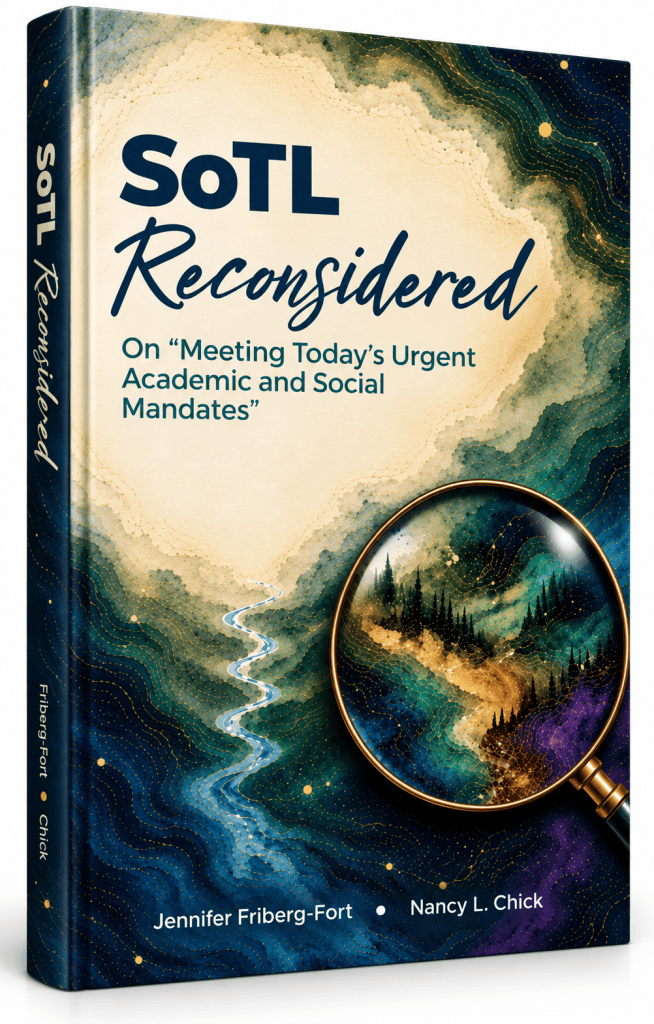
Read SoTL Reconsidered

This pamphlet is licensed under a Creative Commons Attribution-NonCommercial 4.0 International License (CC BY-NC 4.0).
How to Cite
Friberg-Fort, Jennifer, and Nancy L. Chick. 2026. SoTL Reconsidered: On “Meeting Today’s Urgent Academic and Social Mandates.” https://doi.org/10.30707/1790946920.733137
“We proceed with the conviction that if the nation’s higher learning institutions are to meet today’s urgent academic and social mandates, their missions must be carefully redefined and the meaning of scholarship creatively reconsidered.” –Ernest Boyer, Scholarship Reconsidered (1990)
The Story Behind the Pamphlet
A Dinner Conversation
SoTL Reconsidered began over dinner in February 2025 as a half-joking idea for a SoTL “Project 2026,” but what emerged was a serious inquiry into our moment and what we felt called to do—and what we thought SoTL was called to do.
A Connected Project: SoTL in the States
As our thinking evolved, so did our response. We also built SoTL in the States as an ongoing platform for building community among US SoTLers while navigating the changing conditions affecting teaching, learning, and SoTL in our specific contexts.
Why a Pamphlet?
From the 16th through 19th centuries, pamphlets were a popular genre for responding quickly to political and social conditions. Jonathan Swift’s A Modest Proposal (1729), Thomas Paine’s Common Sense (1776), and Mary Wollstonecraft’s A Vindication of the Rights of Woman (1792) illustrate the pamphlet’s immediacy, relevance, and public reach.
Ernest Boyer’s Scholarship Reconsidered (1990) extended this tradition into a modern scholarly context: an incisive intervention in a specific moment, published as a 25,000-word “Special Report” and freely available through ERIC.
Inspired by this lineage, we chose a form designed for timely intervention and broad circulation.

Jennifer Friberg-Fort
Illinois State University
Nancy L. Chick
Texas Woman’s University

